

KBS is one of the best-known shaft brands in modern club building, but the range can feel confusing if you are trying to narrow down the right option for your irons, wedges or graphite setup. The names are familiar, yet the real buying decision sits in the details: weight, launch window, spin profile, feel through transition and how the shaft works with your delivery.
For UK golfers, that decision is rarely just about buying a component online. It normally sits alongside a wider fitting or rebuild question. Are you keeping heads you already trust and changing the engine of the club, or are you building a completely new set from scratch? If you are comparing options, our golf shafts page and club reshafting service are useful places to start.
Contents
- What are KBS shafts?
- How the KBS range is organised
- Steel vs graphite in the KBS line-up
- How weight, flex and bend profile change performance
- How to choose the right KBS shaft
- How KBS fits into a UK fitting and reshafting journey
Talk to Outtabounds about reshafting, replacement shafts, loft and lie adjustments, practical club build advice
Golf Club Reshafting
KBS shaft range overview for UK golfers. Image credit: KBS Golf Shafts
This article forms part of the Outtabounds KBS Shafts Series. If you want a hub page for the full set of guides, visit the KBS Shafts series page.
What are KBS shafts?
KBS is a premium shaft brand created by designer Kim Braly. Within the golf market, the brand is particularly well known for steel iron and wedge shafts, but it now covers much more of the bag with graphite iron, wood, hybrid and putter options as well. That broader range is helpful because golfers can think about feel and ball flight more consistently across different clubs instead of treating each part of the set in isolation.
The simplest way to understand KBS is to think in terms of launch and feel families rather than memorising every model name. Some shafts are built to help golfers launch the ball higher and a little easier. Others are designed to flatten trajectory, tighten spin and give stronger players more control at speed. There are also lighter options for players who want the character of a KBS profile without committing to heavier traditional builds.
| KBS family | Typical job in the bag | General flight idea | Who usually looks here |
|---|---|---|---|
| Tour and Tour Lite families | Irons | Mid to higher launch depending on model | Golfers wanting a smooth KBS feel with playable flight |
| C-Taper and $-Taper families | Irons | Lower spin or more penetrating flight | Stronger players or golfers trying to reduce climb |
| KBS Wedge, 610, Hi-Rev 2.0 and Tour-V Wedge | Wedges | Model-specific launch and spin control | Golfers tuning flights and short-game delivery |
| TGI, PGI, MAX and GENERATION graphite | Irons | From steel-like control to easier launch | Golfers moving into graphite or seeking lighter builds |
| PGW, TGBlack, MAX HL and hybrid options | Woods and hybrids | From Tour-style control to higher launch help | Players tuning tee shots, fairway performance and hybrid gapping |
How the KBS range is organised
Most golfers first come across KBS through the iron shaft line. The KBS TOUR remains the signature profile, while TOUR LITE and TOUR-V change the weight and delivery characteristics around that broader Tour idea. The more flight-reducing families then sit alongside those models, with C-Taper aimed at lower launch and lower spin and the $-Taper line giving a more modern Tour-style profile for golfers who want tighter spin without giving up all workability.
The wedge section is worth treating separately because wedge performance is not simply a copy of what you like in the irons. KBS offers dedicated wedge models so you can decide whether you want flatter, lower-spin knock-down flight, more traditional control or extra launch and stopping power around the green. That is why many golfers end up with one KBS profile in the irons and another in the scoring clubs.

KBS steel shaft family presentation. Image credit: KBS Golf Shafts
Graphite is the other major branch of the range. KBS TGI and PGI are popular with golfers who still want a controlled, iron-like feel, whereas MAX and GENERATION move further toward lightweight launch assistance. In woods and hybrids, the same logic applies. Some models are more player-driven and stable, while others are built to help moderate swing speeds launch the ball more easily.
Steel vs graphite in the KBS line-up
Steel still makes sense for many golfers because it can provide a very direct sense of clubhead position, reliable weight progression and a familiar feel through impact. In the KBS catalogue, the steel iron families cover everything from lightweight performance to lower-spin Tour profiles, so there is a lot of room to fine tune without leaving the material category.
Graphite is no longer only a fallback for slower swingers. Modern graphite iron shafts can suit golfers who want to manage vibration, reduce overall club weight or build a set with a very specific feel pattern. KBS TGI is a good example of a graphite option aimed at players who still want steel-like control. PGI and MAX then open the door to broader playability, while GENERATION is designed around younger or lighter-loading players.
For UK golfers practising indoors, graphite can be especially interesting because repeated sessions on mats can highlight differences in feel and load more clearly than occasional outdoor play. If you are building a home practice environment or comparing equipment with launch monitor data, our guides on how to build a golf simulator in the UK and golf simulator garden rooms show how fitting decisions and practice spaces often connect.
How weight, flex and bend profile change performance
Many golfers talk about flex first, but weight is often the cleaner starting point. A shaft that is too heavy can leave you late, fatigued or overworking to create speed. A shaft that is too light can make the club feel vague, especially if you have a stronger transition. KBS offers enough spread across steel and graphite that you can usually stay in the brand while shifting the total weight in a meaningful way.
Bend profile is the next layer. Two shafts may both say stiff, yet behave very differently because the stiffness distribution along the shaft is not the same. KBS TOUR is known for a smooth, responsive feel and a mid trajectory. TOUR LITE moves lighter and generally higher. TOUR-V aims for lightweight stability with less spin. C-Taper is the obvious move if the ball is climbing too much and you need a flatter, more penetrating look.
That is why launch, spin, peak height and dispersion should all be looked at together. If you only chase one number, you can end up with a build that looks good for a few swings but becomes harder to control over a full round. In a proper fitting, the best option often feels almost boring in the best possible way. The strike pattern tightens, the flight window becomes repeatable and the club stops asking for compensations.
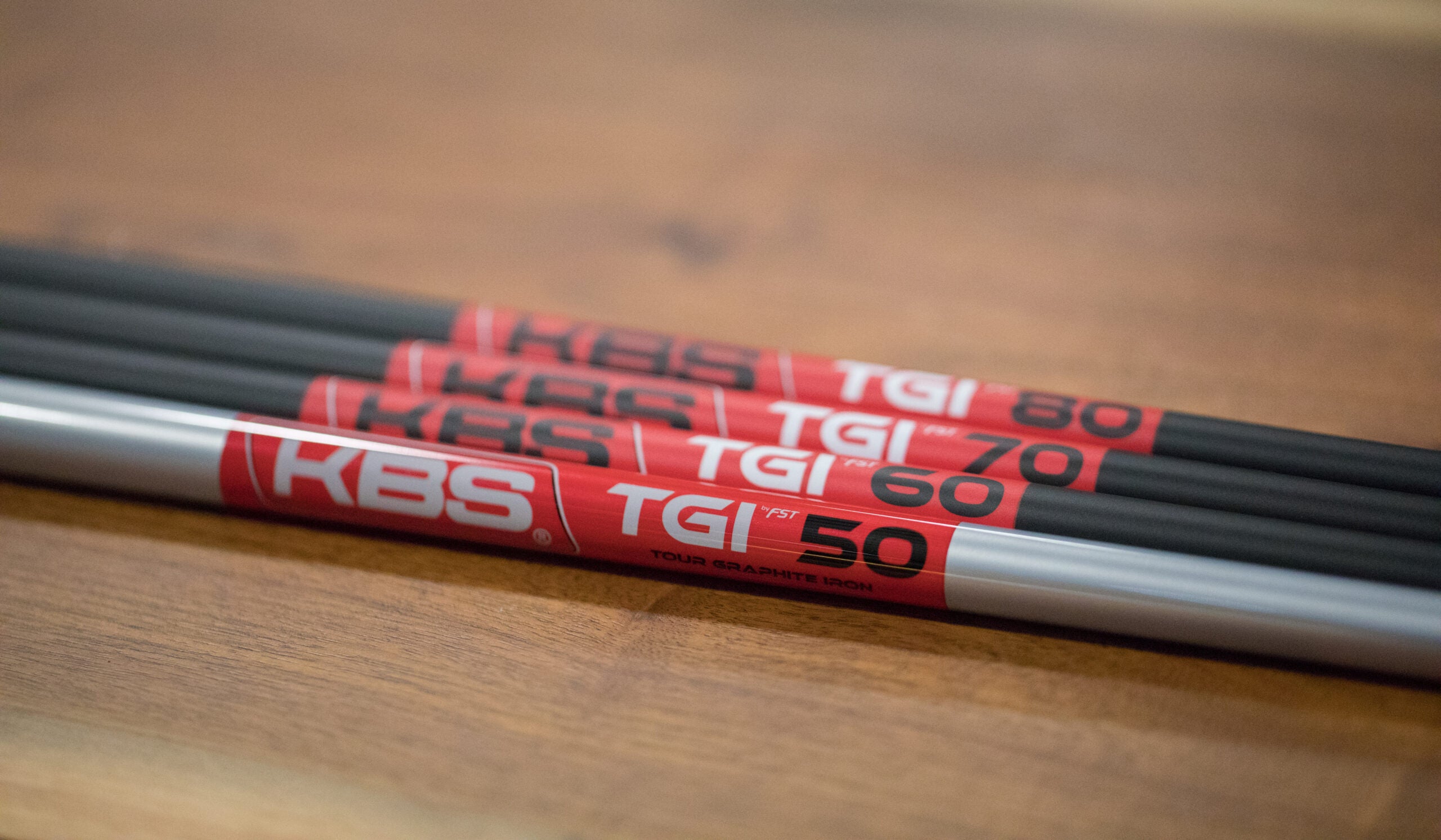
KBS graphite iron shafts lined up for fitting. Image credit: KBS Golf Shafts
How to choose the right KBS shaft
Start with your current ball flight and what you would actually like to change. If your irons launch too low and feel heavy, a move toward TOUR LITE or a graphite option may be sensible. If they climb and spin too much, the C-Taper or a related lower-spin profile may be more useful. If you broadly like what you have but want tighter delivery, the decision may sit in weight, tipping or build details rather than a dramatic profile change.
Next, think about where the clubs are used most. A player who practises weekly indoors and knows their carry numbers may prioritise consistent gapping and start direction. Another player may care more about smoother feel, easier launch and less stress through a long round. Neither approach is wrong, but the buying choice becomes clearer once the goal is defined in playing terms rather than brand terms.
If you need a practical shortlist before spending on a rebuild, use the Outtabounds golf shafts page to compare broader upgrade routes and then speak to a fitter about the exact KBS model that best matches your tempo and strike pattern. Shaft selection becomes much easier when you work from a ball-flight problem instead of a product name.
How KBS fits into a UK fitting and reshafting journey
A lot of golfers in the UK do not need a full new set. They need a smarter build. If the heads are still suitable, reshafting can be the more sensible route because it lets you keep a shape, loft package or visual that already works while changing the part of the club that most directly influences delivery and flight. That is especially appealing when iron heads are in good condition but the current shafts feel too heavy, too soft or simply wrong for the way you now swing.
This is where installation details become important. Taper or parallel tip, playing length, swing weight, grip weight and, for woods, adapter compatibility all affect the finished result. If you are changing driver or fairway shafts, our golf shaft adapter replacement page explains why the small build details are just as important as the shaft name printed on the graphics.
From a commercial point of view, the best KBS decision is usually the one that gives you a repeatable flight window and a build you can trust over time. That may mean a premium steel shaft, a graphite iron conversion or a wedge-specific change rather than a whole set overhaul. The value is in fit, not just in the component itself.
Explore the Full KBS Shafts Series
- KBS Shafts UK Guide: Models, Fitting and How to Choose
- KBS Tour vs Tour Lite vs Tour-V: Which Iron Shaft Fits Your Game?
- KBS C-Taper vs $-Taper vs $-Taper Lite: Launch, Spin and Feel Compared
- KBS Wedge Shafts Explained: Tour, 610, Hi-Rev 2.0 and Tour-V Wedge
- KBS Shaft Weight and Flex Guide: How to Match Your Swing
- KBS Graphite Iron Shafts Explained: TGI, PGI, MAX and GENERATION
- KBS Driver, Fairway and Hybrid Shafts Explained
- When to Reshaft with KBS Shafts and What the Process Looks Like
- Buying KBS Shafts in the UK: Fitting Questions, Build Options and Next Steps
KBS offers enough depth that almost every golfer can find a relevant part of the range, but the right answer nearly always depends on how the club is delivered, not on what is most talked about online. If you begin with ball flight, feel and build goals, the shortlist becomes far more logical.
Use this series to narrow the families that make sense for your game, then take the next step with a proper fitting or reshaft plan. That is how KBS moves from a long catalogue of shaft names to a setup that actually performs on the course.


